
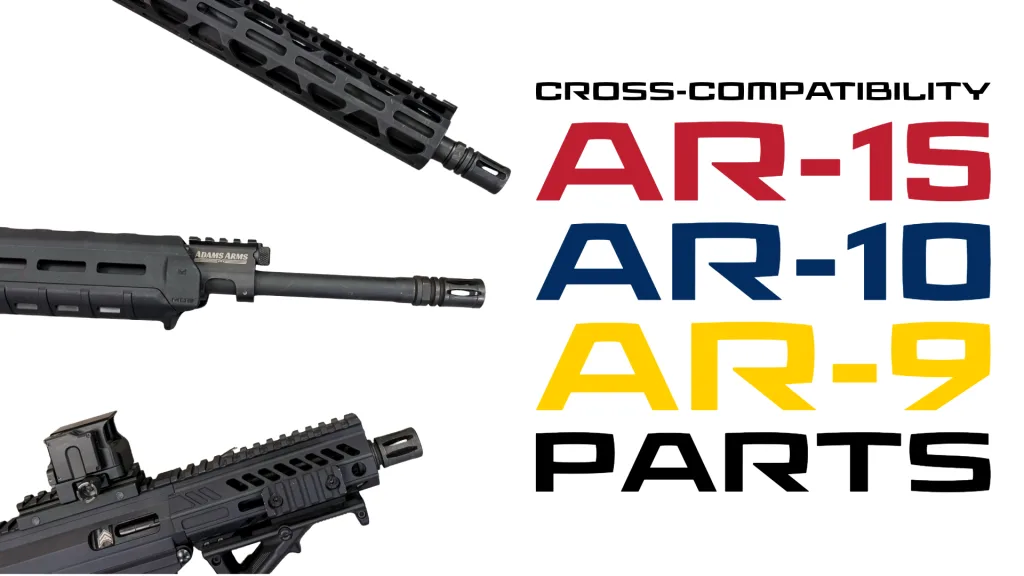
If you’re new to the AR platform, understanding which parts work together across different AR variants can be confusing. AR-15s, AR-10s, and AR-9s all share the familiar AR-style design, but not every part swaps freely between them. In this beginner-friendly guide, we’ll break down which upper and lower receiver components are cross-compatible across these three platforms, which are not, and why. We’ll also include clear charts and point out common pitfalls (like AR-10 pattern confusion and AR-9 mag release differences) so you can build or upgrade your rifle with confidence. Let’s dive in!
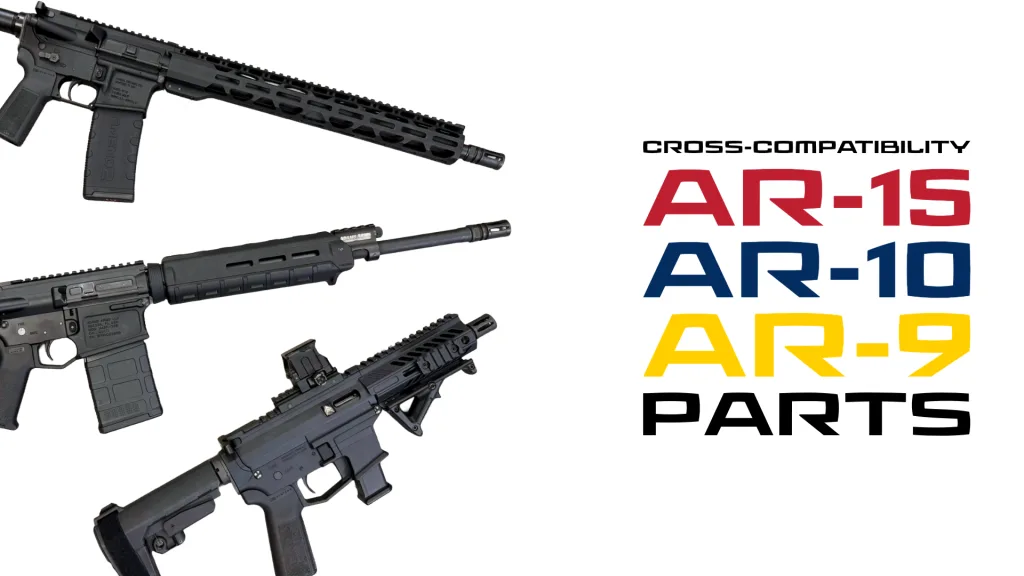
AR-15 vs AR-10 vs AR-9: Getting to Know the Platforms
Before comparing parts, let’s briefly clarify what each platform is:
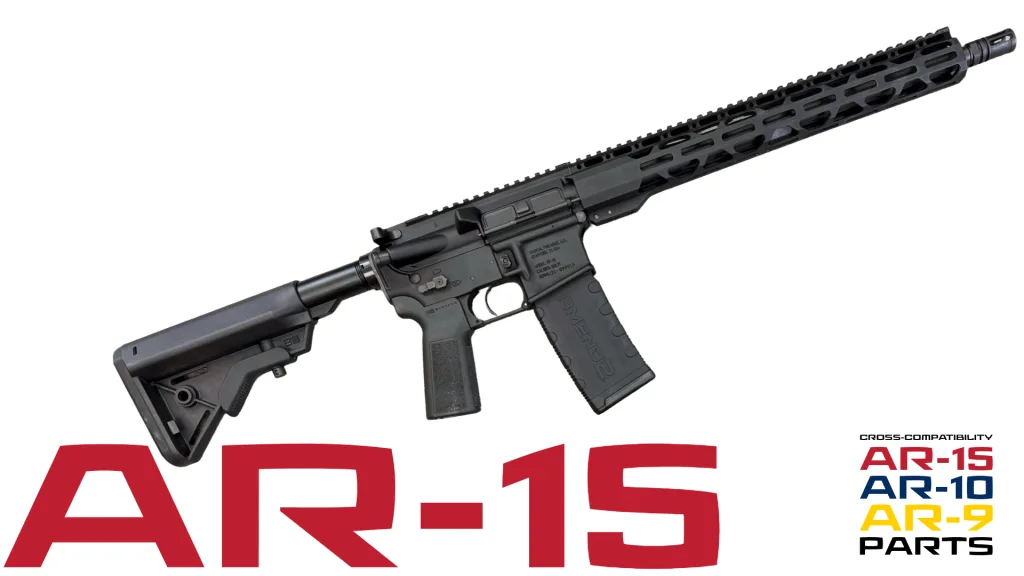
- AR-15: The standard AR-15 is the most common civilian rifle platform in the U.S. It’s the scaled-down 5.56/.223 version of Eugene Stoner’s original designgunbuilders.com. It has “mil-spec” dimensions, meaning most AR-15 parts are universally compatible across brands. It’s lightweight and modular, with millions in circulationgunbuilders.com.
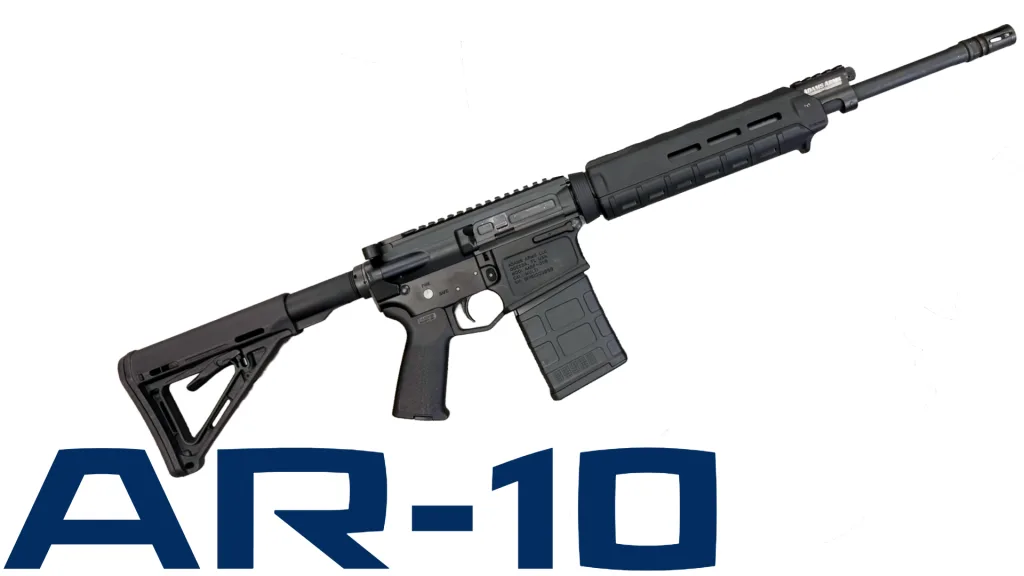
- AR-10: The AR-10 is essentially the “big brother” of the AR-15 – a larger, .308 Winchester/7.62 NATO version of the riflegunbuilders.com. AR-10s are often called “large-frame” ARs. Unlike the AR-15, the AR-10 platform isn’t standardized under one spec; there are a couple of different patterns (more on that later). It has larger receivers and parts to accommodate bigger cartridgesgunbuilders.com. Many modern .308 ARs (often referred to as AR-10s) actually follow the DPMS LR-308 pattern rather than Armalite’s original designgunbuilders.com.
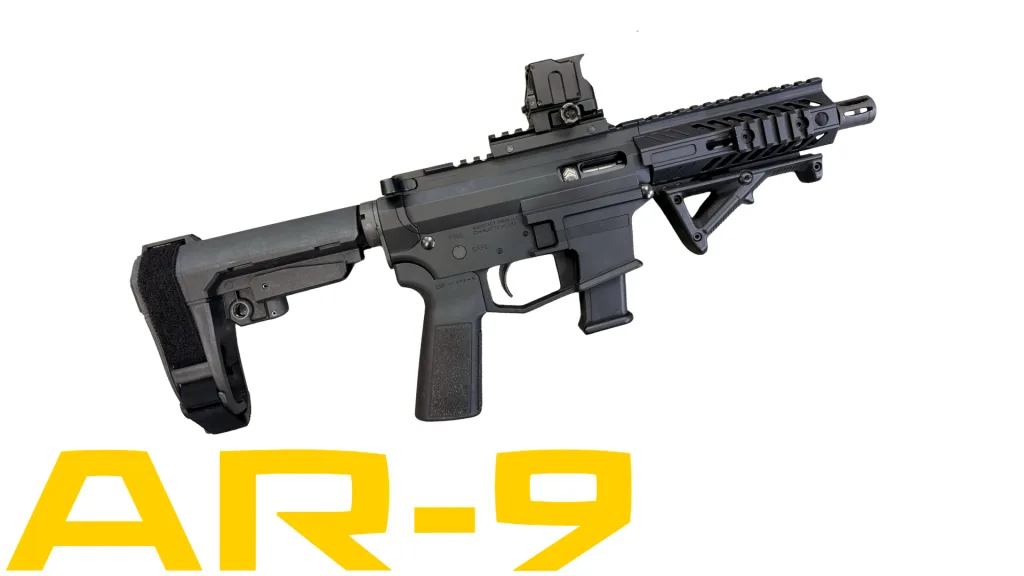
- AR-9: The AR-9 is a 9mm pistol-caliber carbine built on the AR platform. Think of it as an AR-15 that shoots 9×19mm pistol ammo. It keeps the same general layout and many of the same parts as an AR-15modulusarms.com. However, because it uses pistol magazines (like Glock or Colt SMG mags) and operates via simple blowback (no gas system), certain components like the lower receiver, bolt, and magazine interfaces are uniquemodulusarms.com. In essence, the AR-9 borrows heavily from the AR-15’s design, but a few key parts are different to handle the 9mm rounds.
In summary: AR-15s and AR-9s are small-frame ARs (with the AR-9 being a caliber-converted AR-15), while AR-10s are large-frame ARs. Next, we’ll explore how the upper and lower receivers of these platforms differ, and which parts you can mix and match.
AR Upper vs. Lower Receivers (Quick Primer)
An AR rifle splits into two major sections: the upper receiver and the lower receiver. Each contains various components:
- Lower Receiver Assembly: This is the bottom half of the rifle that includes the trigger mechanism, magazine well, pistol grip, buttstock/buffer tube assembly, and controls like the safety and magazine release. It’s the serialized part considered the firearm itself. Beginners often buy a complete lower or assemble one from a stripped lower plus a Lower Parts Kit (LPK).
- Upper Receiver Assembly: The top half of the rifle, which includes the barrel (and gas system in AR-15/AR-10), the bolt carrier group, charging handle, and typically sights or an optics rail. Uppers can be bought complete or built from a stripped upper.
Understanding this split is important because upper and lower parts compatibility can differ. For instance, an AR-15 upper won’t fit on an AR-10 lower due to size differencesblog.primaryarms.com, while an AR-9 upper will fit on an AR-15 lower (they share the same size interface). With that in mind, let’s compare lower receiver components first, then upper receiver components, to see what’s cross-compatible among AR-15, AR-10, and AR-9.
Lower Receiver Parts Compatibility
Many lower receiver small parts are common across the AR family, but a few are not interchangeable between AR-15, AR-10, and AR-9. The table below summarizes which lower parts are “1:1” compatible (meaning you can use the same part in another platform’s lower) and which are unique. We use the AR-15’s mil-spec parts as the baseline:
| Lower Receiver Component | AR-15 vs AR-10 | AR-15 vs AR-9 | Compatibility Notes |
|---|---|---|---|
| Lower receiver (frame) | No ❌ | Yes* ✅ | (*) AR-9 uses an AR-15-sized lower but built for 9mm mags. AR-10 lowers are physically larger – not cross-compatible with AR-15/AR-9 uppersblog.primaryarms.com. |
| Pivot & takedown pins (the two pins joining upper & lower) | No ❌ | Yes ✅ | AR-10 pins are larger/longer to fit the bigger receivers, so AR-15 pins won’t work in AR-10 lowers80percentarms.com. AR-9 uses standard AR-15 pins (same dimensions as AR-15). |
| Trigger group (hammer, trigger, springs, pins) | Yes ✅ | Yes ✅ | The fire control parts are cross-compatible. Standard AR-15 trigger kits drop into AR-10 lowers80percentarms.com and AR-9 lowersmodulusarms.com. (Do note a heavy 9mm blowback bolt can be hard on some light triggers, but fitment is the same.) |
| Safety selector (fire mode switch) | Yes ✅ | Yes ✅ | All three use the same style safety selector and detent/spring80percentarms.com. An AR-15 ambi safety, for example, will work in an AR-10 or AR-9 lower just fine. |
| Bolt catch (holds bolt open on empty) | No ❌ | Mostly Yes ⚠️ | AR-10 bolt catches are larger to grab a bigger .308 bolt, so an AR-15 catch won’t fit an AR-1080percentarms.com. AR-9 lowers often use the same catch as AR-15gunbuilders.com, but the bolt hold-open system can be proprietary. (Example: Many AR-9 Glock-mag lowers add a special linkage or enlarged catch to engage on empty mags, since Glock mags don’t trigger a standard catchgunbuilders.com.) Always use the catch mechanism that comes with your AR-9 lower. |
| Magazine release (button and catch) | Yes ✅ | No ❌ | AR-10s typically use the same mag release assembly as AR-1580percentarms.com. But AR-9 lowers (if for Glock mags) have a completely different mag release – usually a right-side lever or paddle to accommodate the Glock-style mag catch notchgunbuilders.com. None of the AR-15 mag release parts are interchangeable with a Glock-mag AR-9’s releasegunbuilders.com. (Colt-style 9mm ARs that use stick mags may retain a traditional button, but Glock-pattern AR-9s do not.) |
| Buffer tube (receiver extension) | Yes ✅ | Yes ✅ | The tube that threads into the lower is interchangeable across AR-15, AR-10, AR-980percentarms.com. All use either a mil-spec or commercial diameter tube. However, the buffer and recoil spring inside differ (see below). |
| Buffer & recoil spring | No ❌ | No ❌ | The weight/length of the buffer and strength of the spring are platform-specific. AR-10s use a shorter, heavier buffer and stiffer spring to handle the larger BCG and recoil (an AR-15 carbine buffer is too long/light)80percentarms.com. AR-9 blowback systems also use extra heavy buffers (often 5–8 oz) and sometimes a spacer or longer buffer to prevent the 9mm bolt from over-travelinggunbuilders.com. (While an AR-15 buffer can technically go in a 9mm, it may cause excessive travel and weargunbuilders.com.) Always use a buffer and spring suited to your AR-10 or AR-9 build for proper function. |
| Pistol grip (and screw) | Yes ✅ | Yes ✅ | Grips are completely interchangeable across all AR platforms80percentarms.com. The screw and mounting are standardized. Feel free to use your favorite AR-15 grip on an AR-10 or AR-9. |
| Stock (buttstock or brace) | Yes ✅ | Yes ✅ | The stock or brace slides onto the buffer tube, which as noted is common spec. Any AR-15 stock will fit a compatible buffer tube on AR-10 or AR-9. Just ensure your buffer tube diameter (mil-spec vs commercial) matches the stock. |
| Misc. small parts (trigger guard, detents, springs, etc.) | Yes ✅ | Yes ✅ | Most other small lower parts are shared. For example, the trigger guard, takedown/pivot detent pins and springs, buffer retainer pin and spring, castle nut, receiver end plate, and disconnector are universal to all three platforms80percentarms.com80percentarms.com. One exception: AR-9 lowers have an ejector piece (a fixed ejector that kicks out shells) built into the lowermodulusarms.com – something AR-15/AR-10 lowers don’t have, since those rifles use a bolt-mounted ejector. The AR-9’s ejector is unique to 9mm lowersgunbuilders.com and isn’t found on other ARs. |
Table Notes: “AR-15 vs AR-10” indicates whether standard AR-15 and AR-10 versions of that part are interchangeable. “AR-15 vs AR-9” does the same for AR-15 and 9mm AR parts. As you can see, the core fire-control parts (trigger group, safety) and many controls are cross-compatible on all three platforms80percentarms.comgunbuilders.com. On the other hand, parts that relate to the size of the magazine or bolt (like mag catches, bolt catches, buffers) tend to be different.
Comparison of an AR-9 vs AR-15 magazine well and release. The AR-9 lower (left, with a Glock-style 9mm magazine) uses a paddle-style mag release on the right side, whereas the AR-15 lower (right, with a standard 5.56 magazine) uses the familiar left-side push-button release. These magazine-related parts are not cross-compatiblegunbuilders.com.
Upper Receiver Parts Compatibility
Now let’s look at the upper half. The upper receiver assembly includes the stripped upper (the housing), barrel, bolt/bolt carrier group (BCG), charging handle, and related pieces like the forward assist and ejection port cover. Upper parts have some of the most critical incompatibilities between AR-15, AR-10, and AR-9, due to differences in size and operating mechanism. We’ll again use a table to highlight what’s interchangeable:
| Upper Receiver Component | AR-15 vs AR-10 | AR-15 vs AR-9 | Compatibility Details |
|---|---|---|---|
| Stripped upper receiver (the main upper housing) | No ❌ | Yes ✅ | AR-10 uppers are physically larger/longer and will not attach to an AR-15/AR-9 lower (the pin spacing and size won’t match up)blog.primaryarms.com. By contrast, AR-9 uppers are the same size and pattern as AR-15 uppersgunbuilders.com. In fact, many AR-9 builds simply use a standard AR-15 upper receiver since the dimensions are identical – the 9mm bolt is designed to fit in AR-15 upper specsgunbuilders.com. |
| Barrel (and barrel extension) | No ❌ | No ❌ | We won’t dive deep into barrels (caliber-specific), but note you cannot swap barrels between AR-10 and AR-15 – the AR-10’s barrel extension and chamber are much largergunbuilders.com. Similarly, a 9mm AR barrel is very different from a 5.56 barrel (no locking lugs, different feed ramp) and only works with 9mm boltsgunbuilders.com. So each platform needs its own barrel. |
| Bolt & Bolt Carrier Group (BCG) | No ❌ | No ❌ | Each platform uses a unique bolt/BCG matched to its caliber and receiver size. An AR-10 bolt is bigger and won’t fit in an AR-15 uppergunbuilders.com, and vice versa. The AR-9 has an entirely different one-piece blowback bolt (no rotating bolt head) designed for 9mmgunbuilders.com. Bottom line: bolts/BCGs do not interchange among AR-15, AR-10, AR-9. |
| Charging handle | No ❌ | Yes ✅ | AR-10 charging handles are slightly larger/longer to span the wider receiver – an AR-15 handle won’t lock into an AR-10 upper properlygunbuilders.com. However, AR-9s use standard AR-15 charging handles in most casesgunbuilders.com. (Many 9mm uppers even omit the traditional charging handle and go with side-charging designs, but the spec is still based on the AR-15 dimensions.) |
| Forward assist (the plunger that helps close the bolt) | Yes ✅ (usually) | Yes ✅ | Surprisingly, AR-10s that have a forward assist use a part very similar or identical to the AR-15 versiongunbuilders.com. The forward assist location and design didn’t change much. AR-9 uppers often don’t include a forward assist (since a 9mm bolt usually has no serrations for it), but if they do, it’s the same type of part as the AR-15’s. |
| Ejection port cover (dust cover) | No ❌ | Yes ✅ | The AR-10’s ejection port is larger to eject bigger casings, so it needs a longer dust cover – an AR-15 cover is too shortgunbuilders.com. AR-9 uppers use standard AR-15 sized ejection ports/cover assemblies (9mm cases are small, so no size change needed). If you’re using a normal AR-15 upper for an AR-9, the existing dust cover works fine. |
| Barrel nut & Handguard | No ❌ | Yes ✅ | AR-10 upper receivers have a different barrel nut thread pattern than AR-15 (the upper diameter and threads are larger), so you cannot use an AR-15 handguard on an AR-10 or vice versablog.primaryarms.comgunbuilders.com. AR-15 and AR-9, on the other hand, do share barrel nut threads – a 9mm barrel is made to fit in a standard AR-15 upper and use the same barrel nutgunbuilders.com. That means AR-9s can use any AR-15 compatible handguard. (Just be sure any muzzle device you use is made for 9mm diameter if you attach onegunbuilders.com.) |
| Gas system (gas block & tube) | No ❌ | (N/A) | AR-10s and AR-15s both use direct impingement gas systems, but the gas tube length on AR-10s tends to be different (slightly longer) than AR-15 for comparable barrel lengthsblog.primaryarms.com. More critically, an AR-10’s gas tube won’t fit an AR-15 upper due to the size difference of the upper receiver port, and vice versa. As for AR-9 – it doesn’t use a gas system at all (blowback operation), so gas blocks/tubes are omitted entirelygunbuilders.com. You’ll just have an empty gas tube hole in the upper, which is normal for 9mm builds. |
| Sights & optics (iron sights, scopes) | Yes ✅ | Yes ✅ | All three platforms typically feature a Picatinny top rail (or one can be added), so any standard AR sight or optic mount will fit any of them. For example, backup iron sights are interchangeable and sit at the same height on AR-15, AR-9, or AR-10 railsgunbuilders.com. Just keep in mind the different ballistic trajectories when zeroing optics (bigger calibers drop differently, etc.). |
As shown above, AR-15 and AR-9 uppers are very close in design, which is why they share many components. In fact, a dedicated 9mm AR-9 upper is often indistinguishable from a 5.56 AR-15 upper at a glance because they’re the same receiver size. The main differences are internal (the barrel and BCG) and the lack of a gas tubegunbuilders.com.
By contrast, AR-10 uppers are not cross-compatible with the smaller ARs in any major component. The entire upper assembly (receiver, barrel, BCG, charging handle, etc.) of an AR-10 is unique to the .308/large-frame sizegunbuilders.com. If you have a .308 AR, you’ll need .308-specific upper parts and a matching AR-10 lower; you cannot mix an AR-10 upper with an AR-15 lower or vice versablog.primaryarms.com.
AR-10 Pattern Confusion: Not All “AR-10”s Are the Same
A common pitfall for newcomers is the AR-10 naming convention. Unlike the AR-15, which has a military specification that most manufacturers follow, the AR-10 platform was never standardized across the industry. Different companies created their own versions of a .308-sized AR, which led to two dominant patterns: Armalite AR-10 and DPMS LR-308 (also called SR-25 pattern). These have subtle differences:
- Armalite AR-10 (Type A/B): The original design by ArmaLite. It has a distinctive slant-cut on the rear of the upper receiverblog.primaryarms.com and some proprietary parts. Armalite’s current AR-10 line uses Type A (compatible with Magpul SR-25 magazines) or Type B (older style) depending on modelblog.primaryarms.com.
- DPMS LR-308 (Panther Arms): A .308 AR pattern with a rounded upper receiver rear (more like an AR-15 shape, but bigger)blog.primaryarms.com. This pattern became extremely popular for civilian builds. Many brands’ .308 rifles (Palmetto PA-10, Aero M5, etc.) are based on the DPMS design (often called “AR-308”). Magpul’s widely used .308 PMAGs are designed for this pattern.
The bad news: Parts generally do not interchange between Armalite AR-10 and DPMS LR-308 rifles. For example, you cannot fit a DPMS-pattern upper on an Armalite lower, or use a barrel made for one in the other, because the barrel extension and bolt pairing differblog.primaryarms.comblog.primaryarms.com. Even the tiniest differences – like the length of the gas tube or the thread on the barrel nut – can throw off compatibilityblog.primaryarms.com. The good news: many manufacturers have settled on the DPMS pattern for .308 ARs today, but you should always buy matching upper and lower sets or confirm the pattern when building a .308 ARblog.primaryarms.com. If you stick to one pattern, the earlier compatibility rules (trigger groups, safeties, etc., are shared; receivers, BCGs, etc., are not) will hold true within that pattern.
Tip: When shopping for AR-10 parts, look for keywords like “DPMS LR-308 compatible” or “Armalite AR-10 pattern” to ensure you get the right type. If in doubt, buying an upper and lower from the same manufacturer or a matched set is a safe bet for newcomers.

AR-9 Quirks and Common Mistakes
Building or buying an AR-9 (9mm AR) can be a fun project, but there are a few special considerations to keep in mind:
- Magazine & Mag Release: As mentioned, AR-9s typically use pistol magazines (like Glock 17/19 mags). Don’t expect any AR-15 magazine parts to carry over. The mag well on a 9mm lower is completely different, and so is the mag catch mechanismgunbuilders.com. Always use the mag release that comes with your AR-9 lower. New builders sometimes try to install an AR-15 magazine catch in a Glock-mag lower – it won’t work.
- Last-Round Bolt Hold Open: Many AR-9s struggle with holding the bolt open after the last shot, because Glock mags were not designed to interface with an AR-style bolt catch. Some 9mm lowers include a special last-round bolt hold-open (LRBHO) device or modified bolt catch to solve thisgunbuilders.com. Others omit it entirely. This means your AR-9 may not lock back on empty without extra parts. This isn’t exactly a “compatibility” issue, but it’s a common source of confusion. If bolt hold-open is important to you, use a lower that supports it and follow the manufacturer’s parts recommendations.
- Buffer and Recoil Spring: As noted in the table, an AR-9 blowback buffer system needs to be much heavier. A newbie mistake is using a standard AR-15 carbine buffer and spring in a 9mm build – this can result in brutal recoil and damaged parts from the bolt slamming too hard. Instead, get a 9mm heavy buffer (often ~5–8 oz) and, in many cases, a stronger spring (some builders even use a .308 carbine spring for 9mm)mdshooters.commdshooters.com. Some 9mm buffers are longer to reduce travelgunbuilders.com. Following a proven 9mm buffer/spring combo will save you headaches in tuning the gun.
- No Gas System: Don’t waste time looking for a gas tube for your AR-9 – it doesn’t use one! Unlike AR-15/10 which are gas-operated, the AR-9 is direct blowback, meaning the bolt cycles purely from the force of the cartridge firing. Thus, AR-9 barrels have no gas port, and you won’t install a gas block or tube on themmodulusarms.com. Beginners sometimes worry they “forgot the gas tube” – but in a 9mm build, that’s intentional. The empty hole in the upper where a gas tube would go is left unusedgunbuilders.com.
- Trigger Compatibility: Mechanically, any AR-15 trigger will fit in an AR-9, but be aware that 9mm blowback ARs cycle with more abrupt force. This can jar some light aftermarket triggers. It’s not that the trigger isn’t compatible, but some users report the hammer can follow or parts wear faster with certain match triggers in 9mm. Mil-spec style triggers or those rated for PCC (pistol caliber carbine) use tend to be more robust for AR-9 usemdshooters.com. If you experience trigger malfunctions in a new AR-9, the trigger could be the culprit – a heavier hammer spring might be needed.
Wrapping Up: Key Takeaways
For new gun owners, the AR platform’s mix-and-match modularity is part of its appeal. Just remember that not every AR is the same. Here’s a quick recap of what we covered:
- AR-15 and AR-9 = mostly compatible. The AR-9 (9mm) is built on the AR-15’s frame, so it uses almost all the same lower parts (trigger group, pins, safety, etc.)modulusarms.com and the same upper receiver dimensionsgunbuilders.com. You can use AR-15 furniture, sights, and many internals on a 9mm AR. The exceptions are parts related to the caliber: the 9mm barrel, bolt, magazine interface, buffer, and ejector are unique to AR-9smodulusarms.com.
- AR-15 and AR-10 = a few shared parts, many differences. The AR-10’s larger size means uppers and lowers don’t mix with AR-15, and big components like the barrel, BCG, and charging handle are not sharedgunbuilders.comgunbuilders.com. However, a surprising number of small parts are interchangeable. AR-15 triggers, grips, safeties, and buffer tubes can be used in AR-10 builds80percentarms.com80percentarms.com. On the other hand, AR-10-specific items include the receivers themselves, the bolt catch, pivot/takedown pins, and the buffer and spring, among others, which must be .308-pattern parts80percentarms.com80percentarms.com.
- Within AR-10s, stick to one pattern. If you decide to build a .308 AR, ensure your upper, lower, BCG, and barrel all follow the same design (DPMS or Armalite). You cannot cross an Armalite AR-10 bolt or upper with a DPMS LR-308 barrel, for example, without running into issuesblog.primaryarms.comblog.primaryarms.com. Many modern components are DPMS-pattern, but double-check to avoid expensive mix-ups. When in doubt, buy matching sets or consult the manufacturer’s compatibility info.
- Magazines and Calibers: We didn’t focus on magazines or caliber changes in this guide, but know that magazines are never cross-compatible between AR-15, AR-10, and AR-9. Each takes its own type of mag appropriate for the cartridge. Likewise, you can’t simply run .308 in an AR-15 or 5.56 in an AR-10 by swapping uppers – the whole platform is different to handle those sizes.
In the end, building confidence with these platforms comes from understanding the boundaries of compatibility.The AR world works like a giant Lego set—you’ve got standard-sized Legos (AR-15/AR-9) and a bigger Duplo set (AR-10). Both are fun, but the pieces from one won’t clip onto the other. Use this guide as a reference as you plan your build, and you’ll save yourself from ordering the wrong parts.
Happy building and safe shooting! With the right components in the right places, you’ll have a great time assembling your AR, whether it’s a light 5.56, a hard-hitting .308, or a pistol-caliber plinker. Enjoy the process, and welcome to the AR community!
Sources: Much of the compatibility info above is drawn from AR component guides and industry resources for AR builders. Key references include parts compatibility charts from 80% Arms and GunBuilders Depot80percentarms.comgunbuilders.com, platform differences explained by Primary Arms and Modulus Armsblog.primaryarms.commodulusarms.com, and experienced builders’ tips from forumsmdshooters.com. These sources reinforce the do’s and don’ts of mixing AR-15, AR-10, and AR-9 components discussed in this article. Enjoy your build!